
Why workforce development is now central to economic development
In conversations with local governments, regional development organisations and industry groups across Australia, one issue comes up more than almost any other: workforce shortages.
Businesses cannot find the workers they need. Housing projects are delayed because of construction labour shortages. Manufacturers struggle to recruit skilled tradespeople. Health and care providers face persistent workforce gaps. In many regions, workforce constraints have become one of the biggest barriers to economic growth.
The current national unemployment rate is 4.5%, a rate many economists regard as being close to full employment. In simple terms, there is very little spare labour capacity available. As Australia's population ages and competition for skilled workers intensifies, workforce challenges are likely to become more significant, not less.
Yet there is often uncertainty about what local economic development organisations should do about it.
That hesitancy is understandable. Skills and workforce policy is largely the responsibility of state and federal governments. Training systems, migration settings and employment services are generally outside the control of local government. Many councils are wary of taking on responsibilities that belong to other levels of government.
The result is that workforce development can fall into a gap. Everyone agrees that it’s important, but no one takes clear ownership at the local level. This is a problem because workforce is not a peripheral economic issue. It is one of the foundations of economic growth.
At Econovation, we often describe economic growth through the lens of the three Ps: population, participation and productivity. Population refers to the number of people in a place. Participation refers to the share of those people engaged in the workforce. Productivity refers to the value each worker creates.
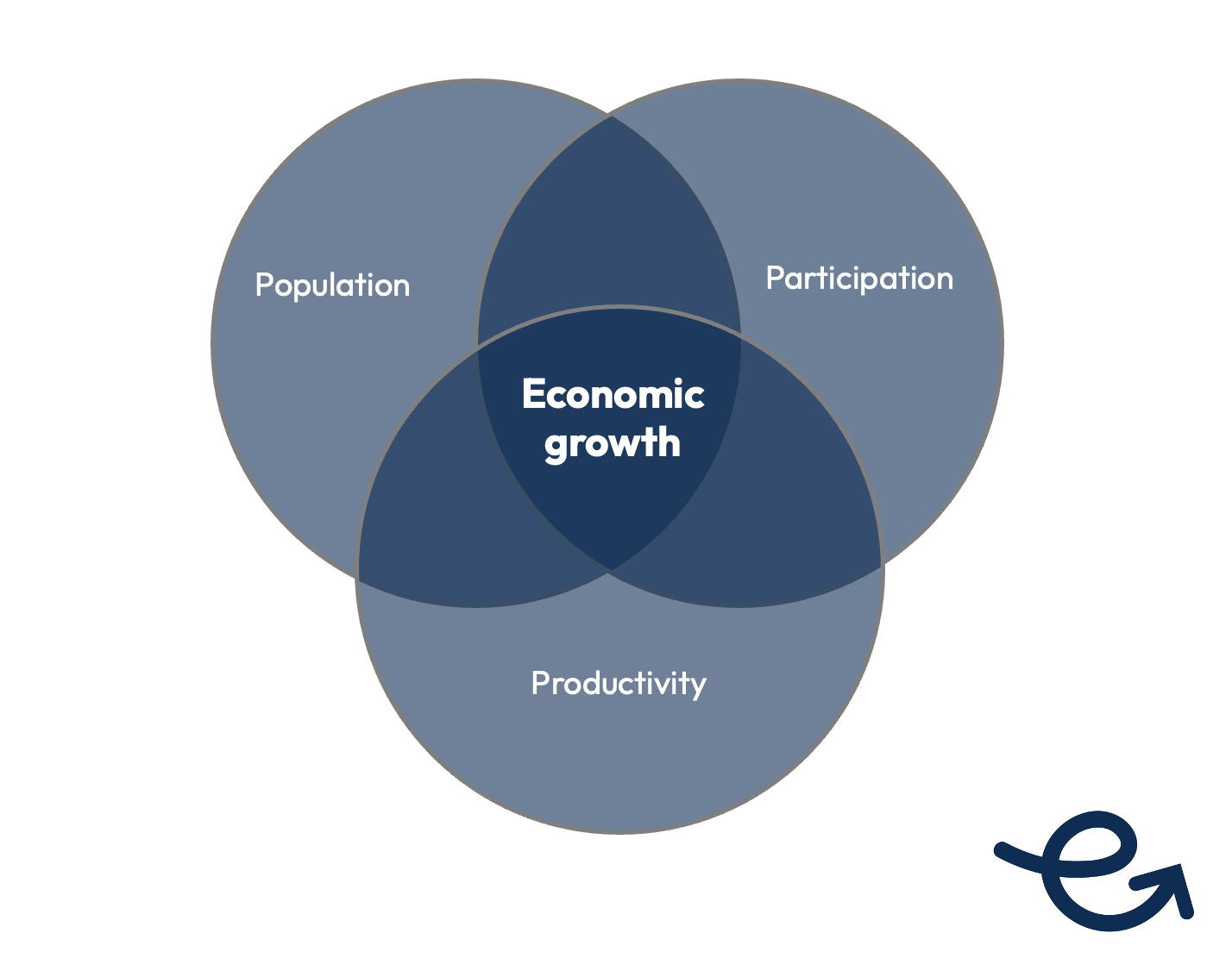
The 3 Ps of economic development
Workforce development influences all three. It can help attract and retain people in a region. It can increase workforce participation by connecting more people to employment opportunities. And it can lift productivity by improving skills, capability and workforce performance.
Yet many economic development strategies focus heavily on investment attraction, business growth and infrastructure while giving relatively little attention to workforce issues.
Fortunately, there are already examples of local governments stepping into this space.
The draft Economic Growth Strategy developed by the City of Whittlesea positions ‘Skills and knowledge for the future’ as one of its four core strategic directions. The strategy recognises that strengthening pathways into jobs, aligning training with workforce demand, and building workforce capability are central to the municipality's long-term economic success. Workforce is recognised as a core economic development priority.
Hume City Council provides another example. Through initiatives such as the Hume Community Jobs and Skills Working Group and Hume Multiversity, the council has actively brought together employers, training providers and community stakeholders to address local workforce challenges and help residents access future employment opportunities.
Neither of these councils is attempting to run the training system. Instead, they are playing the role local government often plays best: convening stakeholders, identifying local needs, coordinating action and advocating for solutions.
In almost every other area of economic development, local governments play an active leadership role even when they lack formal responsibility. Councils advocate for transport infrastructure they do not own. They support industry development despite having limited policy levers. They promote investment attraction without controlling investment decisions.
Workforce development should be viewed in exactly the same way.
Local governments can help identify workforce constraints, document demand, connect employers with training providers, strengthen the evidence base for advocacy and ensure workforce considerations are embedded in broader economic development planning.
The regions that perform best over the next decade are likely to be those that recognise workforce as a core economic development issue, not someone else's responsibility.
Local economic development without a workforce focus is increasingly incomplete.