
When governance boundaries don’t match economic reality
Economic geography almost never aligns with administrative boundaries.
Councils, states and even national borders are useful governance constructs, but economies don't operate neatly within them.
The OECD uses the concept of Functional Regions to describe this reality. Functional regions are defined by economic linkages such as commuting patterns, labour markets, supply chains and industry connections. They reflect how people live and work, how firms trade and how capital flows. They describe integrated economic systems.
Examples are everywhere. Greater Melbourne operates as a single labour market spanning more than 30 local government areas. Albury–Wodonga functions as one economy despite sitting across two states. The Productivity Commission has identified 89 functional economic regions across Australia. None align neatly with council or state boundaries.
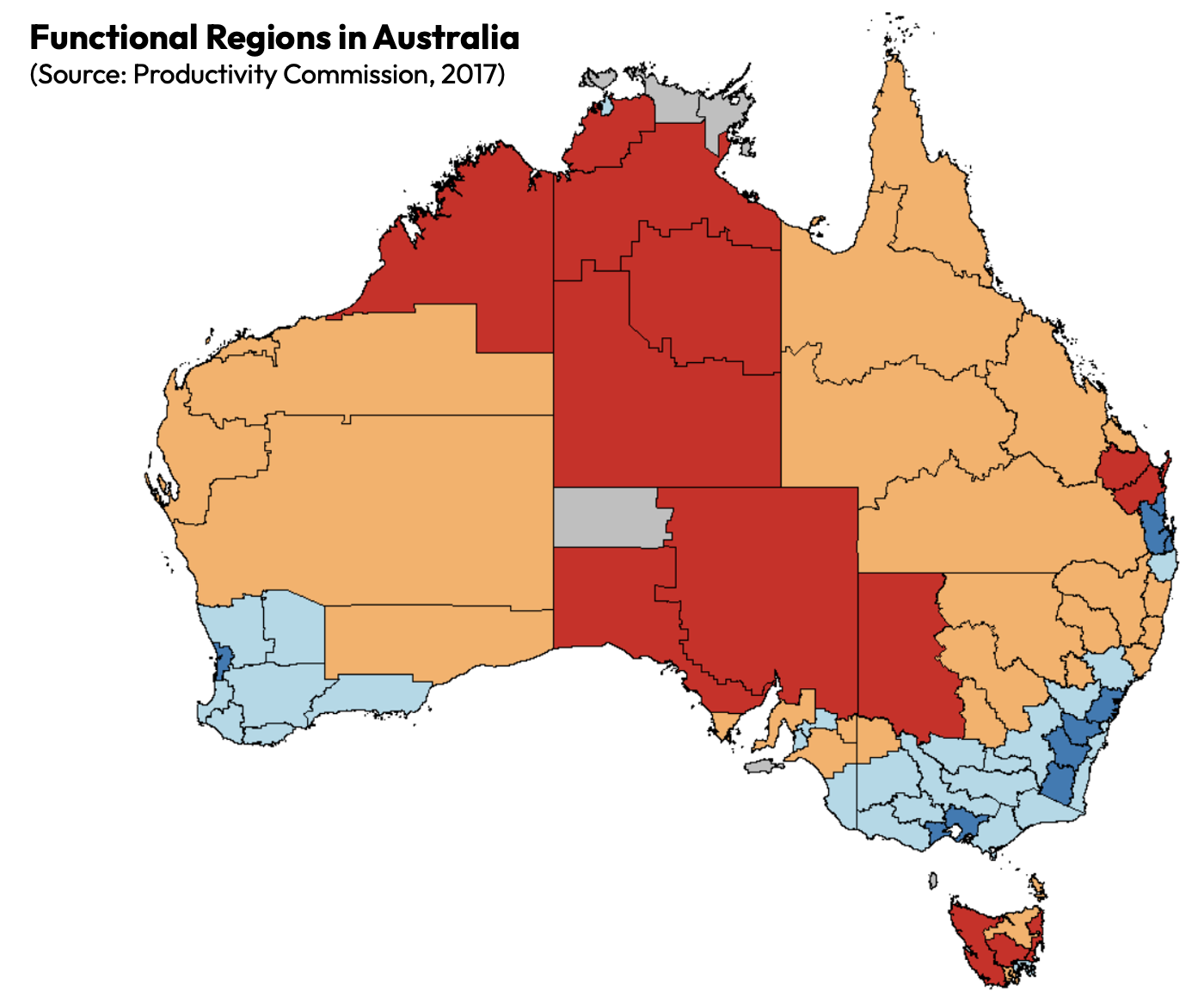
Functional economic regions in Australia, based on labour market and economic linkages (Productivity Commission). The shading reflects adaptive capacity in the original report and is not the focus here.
This misalignment shows up repeatedly in Econovation’s work with clients.
In one fast-growing outer metropolitan area, early discussions focused on securing more local professional jobs. Analysis showed that a large share of residents working in finance and related industries were employed in major employment clusters elsewhere in the city, with wages flowing back into the municipality, strengthening the local economic base. That commuter income was an asset, not a weakness. Strategy shifted toward building on the municipality’s role within the wider labour market, strengthening its comparative advantages rather than attempting to replicate city-based industries locally.
In regional Victoria, work on a regional strategic plan revealed a similar dynamic. Workforce movements, supply chains and industry strengths operated at a scale much broader than individual shire borders. In parts of the region, there were effectively two overlapping functional economies. Economic development at a regional scale made more sense than fragmented local efforts.
These examples highlight several implications that flow from a focus on functional regions.
Strategies that assume local economies are closed systems don't align with how economic activity actually works. Workers commute across boundaries. Firms operate across jurisdictions. And business and investment decisions are made at regional or national scale, not at the scale of a single council.
Strong performance within a functional region depends on specialisation and connectivity. Not every place needs to host every industry. Prosperity is shaped by access to high-quality employment across the wider system, not simply by job numbers within a boundary.
Assets outside formal boundaries still shape local prosperity. Major hospitals, universities, industrial precincts and transport infrastructure influence labour markets and firm behaviour across multiple councils. Local strategy needs to account for these external drivers.
Collaboration is not optional. Functional economies require coordination across councils, agencies and - at times - state governments. In Australia, this logic underpins regional economic development strategies and bodies such as Regional Development Australia committees. Trust and partnership-building are core economic capabilities.
Economic development requires senior-level leadership. Working effectively across functional regions requires senior leadership with the authority to align portfolios and negotiate across institutions. It cannot be treated as a narrow or junior function.
The mismatch between economic reality and administrative geography is structural. Economic development that ignores it tends to produce weak strategy and poor outcomes.